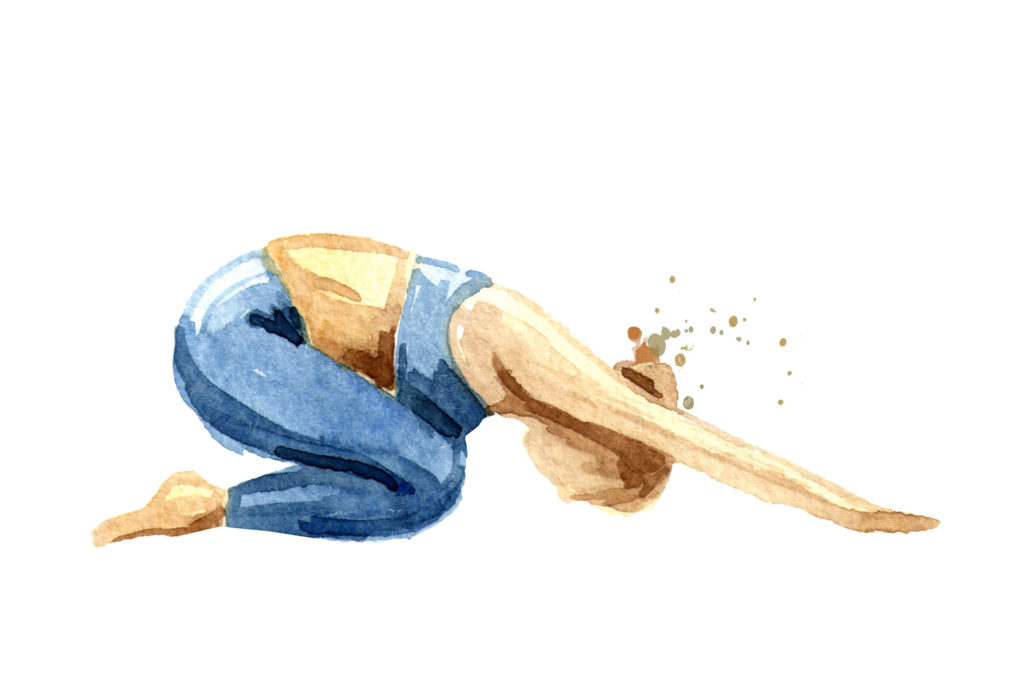
Balasana, Child’s Pose, is a restorative pose that can be practiced on its own or as part of a routine. A forward fold, Balasana provides an opportunity for us to elongate all the muscles along the spine and find a deep release, relieving soreness in the muscles of the shoulders and hips. Emotionally, Balasana allows us to feel safe and nourished while retreating to a quiet place within ourselves, reminding us to reconnect to our breath while surrendering any worries and fears.
You can enjoy practicing Balasana on its own, in the midst of a particularly busy day when you need a few minutes’ retreat. You can start your practice with Balasana, particularly when the focus of the more active part of your practice might be on forward folds. When you need a break after a vigorous flow, Balasana can be the answer, allowing you to return to your center and just be, without attempting to make anything happen. The only requisite is a commitment to be present with our breath, thoughts, and emotions, allowing the natural ebb and flow.
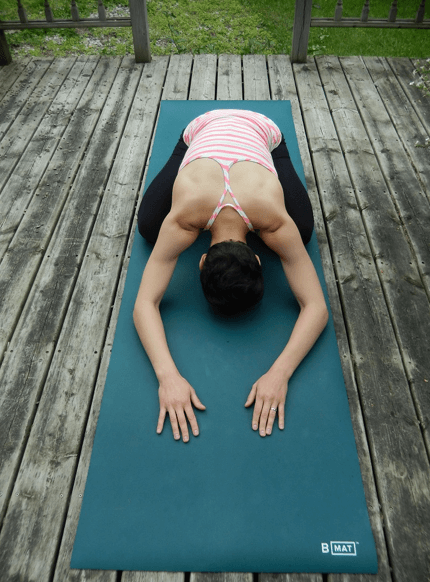
1. Variation with knees wide apart, big toes touching.
To come into the pose, start in a kneeling position. You may choose to keep the feet, ankles, shins, and knees together, or bring the big toes to touch and separate the knees to the width of your yoga mat. If your knees are sensitive, you may wish to place a folded blanket underneath your knees and/or roll a towel or blanket and position it into the creases behind your knees. To address ankle sensitivity, place a rolled blanket underneath the ankles and/or feet. A block or a blanket can also be placed between the ankles and buttocks. Stretch your arms in front of your mat and begin to slowly fold forward from the hips as you walk your hands out for support. Bring your forehead down to the mat and extend your arms out in front of you. Alternatively, to release any tension in the shoulders, you might prefer to allow the arms to relax by the sides of your body, with the palms of the hands facing upward, resting close to the feet.
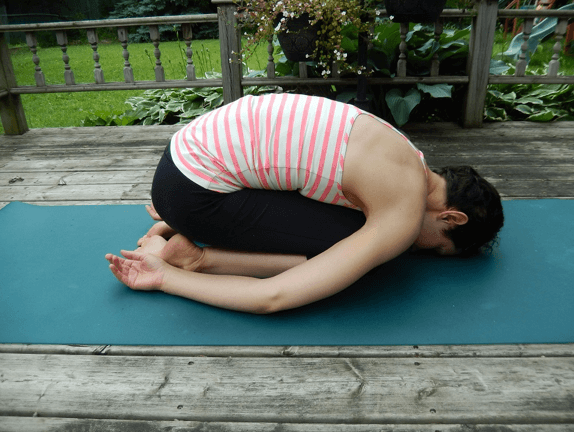
2. Variation with knees and big toes together, shoulders rounded, and arms resting down by the feet.
If your forehead does not naturally reach the floor in this pose, you may place a bolster and/or block under your forehead. A bolster (or pillows/blankets) can also be used to support your torso in this pose. Elevate the props to the necessary height. We need to ensure that we feel comfortable enough in this pose to allow ourselves to fully relax.
Ideally, the forehead should be pressing down into the mat or props. However, if this does not feel comfortable, you may rest on one cheek while turning the head to one side. Be sure to switch sides after several breaths for the same number of breaths on the other cheek.
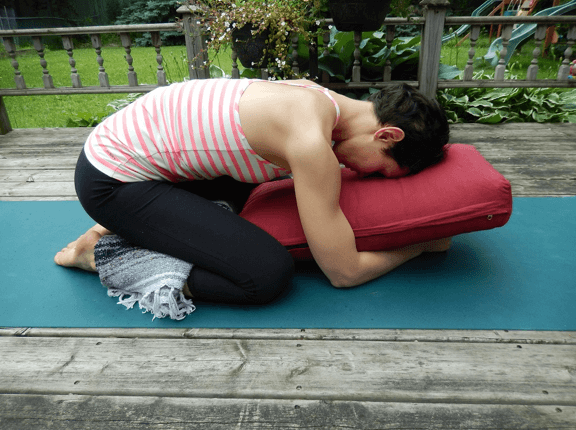
3. Variation with a blanket folded between the buttocks and heels (to address any knee sensitivity). The bolster is used in order to lift the floor closer to the forehead. You may use the hands under the bolster to lift it higher, or place a block under the bolster and allow the hands to rest on the mat.
Remember to round your spine as much as possible in this pose, inhaling into the back body: the hips and kidneys, the lower back, the mid-back, and the upper back, into the cervical vertebrae. Then, exhale and release any tension from the neck, the space between the scapulae, the ribs, the lower back, and the hips. Continue to breathe fully and remain in the pose for as long as you wish. We recommend staying in the pose for at least 8-10 deep breaths.
To rise back up, on an inhale, bring the hands under the shoulders. Pressing the palms of your hands firmly down into the mat, start to lift your head and torso back up. Roll the shoulders back to neutralize your posture.
Enjoy the freedom and expansion that you have created in your body!
** Always consult your doctor before starting this or any other exercise program!
*** If you’re pregnant, a supported version of Child’s Pose would be a good option. Follow the modifications above to suit your body at this time, sliding the bolster forward, closer to your knees than to the pelvis. This will allow the belly to remain off the bolster and should provide sufficient space for you to lengthen your spine.
YOU MAY ALSO LIKE:
FIVE RESTORATIVE YOGA POSES TO HELP YOU SLEEP BETTER
There are many different kinds of yoga, each with its own benefits. Among the various styles, the one that is best…
ARE YOU STRESSED OUT?
Are you feeling stressed out? Increase the feelings of harmony between your mind and body by adding yoga to your daily…

EXPLORING THE OCEAN’S ABUNDANT WELLNESS BENEFITS
Who doesn’t love a trip to the beach to experience the relaxing rhythms of the waves, smell the fresh, salty sea…
WHY WE NEED IODINE IN OUR DIET
According to WebMD, since the early 70s changes in Americans’ diet have led to decreasing intake of iodine. We need iodine…
PRACTICING SELF-CARE THROUGH AYURVEDA
Ayurveda is a 5,000-year-old form of medicine originating inside the Vedic culture of India. Both Tibetan and Chinese medicine have their roots…
WATERMELON – MORE THAN A SUMMER THIRST QUENCHER
→ Watermelons originated in Africa. They were first cultivated in Egypt. They were so revered there that they were placed in…